 AI is changing software faster than most businesses realise.
For years, companies have relied on single-purpose SaaS tools for specific functionalities such as quizzes, assessments, forms, automation and lead generation funnels. But today, AI tools like ChatGPT and Lovable.dev allow businesses to rapidly create custom software themselves.
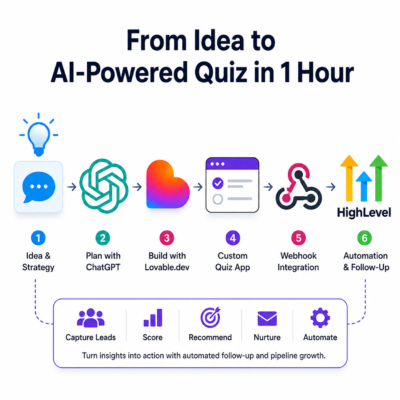
Recently, I replaced ScoreApp with a custom-built AI-powered quiz application. The first working version took about an hour to create.
The result was not just cheaper. It was more flexible, more tailored to my exact use case and easier to refine over time.
| Did you find this content useful? |
|---|
| Sign up for my free Marketing Hints, Tips and Hacks email newsletter every Tuesday at 11am. => Sign up here <= |
Quick Summary
I replaced ScoreApp with a custom AI-built quiz created using ChatGPT and Lovable.dev. The quiz includes scoring, personalised recommendations, webhook integrations and automated follow-up using HighLevel as the central AI Operating System for marketing automation and CRM.
Can You Replace ScoreApp With AI?
Yes. Tools like ChatGPT and Lovable.dev now allow businesses to rapidly create custom quiz funnels, assessments and lead generation tools without traditional software development.
For many businesses, this means they can now create bespoke tools instead of paying for additional monthly SaaS subscriptions.
That does not necessarily mean every SaaS platform disappears. But it does mean many single-purpose tools are becoming vulnerable to AI-generated alternatives.
What Is Vibe Coding?
Vibe coding is the process of building software conversationally using AI tools rather than writing traditional code manually.
Instead of hiring developers and writing long specifications, you describe what you want, refine the logic conversationally and iteratively improve the software.
That is exactly how this project was built.
Why I Wanted to Replace ScoreApp
I completely understand why ScoreApp became popular.
It solves genuine business problems:
- Lead generation quizzes
- Scoring systems
- Assessments
- Recommendations
- Funnels
But increasingly, many businesses are questioning whether they still need separate single-purpose tools for every task.
In my case, I wanted to build a Voice AI Readiness Quiz for my website.
The purpose of the quiz was simple:
- Ask a series of questions
- Score the answers
- Categorise the user
- Provide recommendations
- Trigger marketing automation follow-up
Traditionally, this would likely have meant another monthly subscription.
Instead, I decided to build the application myself using AI.
How I Built the Quiz
- Mapped out the quiz logic in ChatGPT
- Created scoring categories and recommendations
- Designed the assessment questions
- Built the front-end using Lovable.dev
- Refined the layout and logic conversationally
- Added webhook integrations
- Connected the quiz to HighLevel
- Tested and refined the user experience
The entire process felt far more conversational than traditional software development.
It started with a simple prompt:
“Can you help me create a ScoreApp style quiz for my website using Lovable.dev?”
From there, the application evolved step by step through conversation and refinement.
The Prompting Process Matters More Than The Coding
One of the biggest shifts AI introduces is that the real value increasingly comes from business logic, customer understanding and prompting rather than traditional programming knowledge.
The first stage was not coding. It was thinking.
I worked through:
- The quiz structure
- Result categories
- Scoring logic
- Recommendations
- Customer journeys
- Business use cases
Very quickly, the quiz became more sophisticated than the original idea.
For example, during the conversational refinement process, the concept of specialist AI routing emerged.
Rather than treating every enquiry the same, the system could eventually route enquiries to specialist AI agents.
An electrical contractor, for example, might eventually have:
- An EV charger AI agent
- An emergency call AI
- A domestic wiring AI
- A commercial enquiries AI
This is where AI-assisted development becomes powerful.
You are no longer constrained by the fixed structure of a SaaS platform. You can rapidly adapt software around your exact business process.
The Questions Matter More Than The Technology
One of the most important parts of the process was designing the actual assessment questions.
The quiz explored areas such as:
- Missed calls
- Lead handling
- Voicemail follow-up
- CRM usage
- Repeat customer questions
- Urgency of implementation
- Average customer value
Some example questions included:
- How many calls does your business miss in a typical week?
- What percentage of your calls are new enquiries?
- Would it help if calls were summarised and added to your CRM automatically?
- How quickly do you want to improve your call handling?
This type of conversational business logic is where AI-generated software becomes extremely effective.
Then Came Lovable.dev
Once the structure and logic were clear, I used Lovable.dev to generate the first working version of the application.
This is where things become genuinely exciting for marketers, agencies, consultants and small businesses marketers.
Instead of:
- Hiring developers
- Writing technical specifications
- Waiting weeks or months
- Managing expensive development projects
I could simply continue the conversation.
I refined:
- Layouts
- Question flow
- Recommendations
- Styling
- Scoring
- Integrations
- Calls to action
Because the system was already functional, every iteration became faster.
Lovable.dev vs ScoreApp
ScoreApp is a polished SaaS platform specifically designed for quizzes and assessments.
Lovable.dev is different.
Rather than giving you a fixed platform, Lovable.dev allows you to rapidly create bespoke tools using AI-generated development workflows.
Unlike traditional quiz platforms like ScoreApp, AI-generated tools can be customised around your exact business process.
This creates huge flexibility for businesses willing to experiment.
But Here’s the Important Point Most People Miss
I do not believe vibe coding completely replaces traditional software development.
What it does do is massively accelerate:
- Prototyping
- Testing
- Experimentation
- Validation
- Deployment
The first version of an app may not be the final enterprise-grade system.
But it might be:
- Good enough to launch
- Good enough to test
- Good enough to generate leads
- Good enough to validate the idea
Later, the application can become more robust using tools like Claude Code or more traditional development approaches.
That dramatically changes the economics of software for small businesses.
The Finished Quiz
Here is the final result:
This is not just a static quiz.
The application includes:
- Scoring
- Categories
- Personalised recommendations
- Webhook integrations
- Lead routing
- CRM integration
- Marketing automation triggers
Where HighLevel Fits In
Although this project was primarily about replacing ScoreApp, HighLevel still plays an important role.
Once somebody completes the quiz:
- The data is sent via webhook
- HighLevel captures the lead
- Automation takes over
- Follow-up sequences begin
- Opportunities can be created
- Workflows can trigger
- Appointments can be booked
This is why I increasingly describe HighLevel as an AI Operating System.
The AI-generated front-end tools are becoming easier and easier to build.
But businesses still need a central operational layer that connects:
- CRM
- Automation
- Communications
- Lead nurturing
- Workflows
- Pipelines
- AI systems
That is where HighLevel becomes incredibly powerful.
I wrote more about that concept here:
HighLevel Is Becoming the AI Operating System for Your Marketing and Business
The Bigger Opportunity
I think many business owners still underestimate what is happening here.
The barrier to software creation has dropped dramatically.
You no longer necessarily need:
- A development agency
- Months of planning
- Large budgets
- Technical expertise
Instead, businesses can increasingly:
- Build tools themselves
- Iterate rapidly
- Test ideas quickly
- Create bespoke workflows
- Replace expensive subscriptions
- Experiment at speed
Most importantly, businesses can increasingly create software that fits their process rather than forcing their business to fit somebody else’s software.
Frequently Asked Questions
Can ChatGPT build a quiz funnel?
ChatGPT can help structure quiz logic, scoring systems, recommendations, workflows and prompting. Then, combined with tools like Lovable.dev, businesses can rapidly build custom quiz funnels and lead generation systems.
What is Lovable.dev used for?
Lovable.dev is an AI-powered application builder that allows users to create websites, tools and applications conversationally using AI-assisted workflows.
Can AI replace SaaS tools?
In some cases, yes. AI-assisted development tools now allow businesses to rapidly create bespoke alternatives to many single-purpose SaaS applications.
How long does it take to build a quiz using AI?
Simple working versions can sometimes be created in hours rather than weeks, especially when using conversational AI development tools.
Do you still need developers?
Sometimes yes. Vibe coding is excellent for rapid prototyping, testing and deployment, but more robust enterprise systems may still benefit from traditional development practices.
Final Thoughts
I do not believe every SaaS tool will disappear overnight.
But I do think many single-purpose tools are going to face increasing pressure from AI-assisted custom development.
The businesses that benefit most will likely be the ones willing to:
- Experiment
- Prototype quickly
- Integrate systems intelligently
- Embrace AI-assisted workflows early
In my case, replacing ScoreApp with a custom AI-built solution took about an hour.
That would have sounded ridiculous even a couple of years ago.
Now it is becoming normal.
Written by Julian Mills – HighLevel consultant and marketing strategist. About Julian Mills.
Book a Discovery Call with Julian.
Check out HighLevel at HighLevel agency – MarketerM8.com

