Your business started with one phone.
Then somebody else needed to answer it.
You hired more staff. Someone started working from home. Customers needed transferring between colleagues. Staff started giving out personal mobile numbers.
And suddenly you’ve realised:
We need a proper business phone system.
If that sounds familiar, you’ve probably started searching for:
| Did you find this content useful? |
|---|
| Sign up for my free Marketing Hints, Tips and Hacks email newsletter every Tuesday at 11am. => Sign up here <= |
Small business phone systems, VoIP phone systems, cloud phone systems or office phone systems.
But before signing up for another standalone phone platform, there’s an alternative worth considering.
Particularly if your business also needs a CRM.
HighLevel can potentially give you both.
And increasingly, it can add something much more interesting:
A 24/7 AI receptionist.
What If Your Phone System Came With a 24/7 AI Receptionist?
A traditional business phone system solves the technical problem of getting calls to the right people.
It doesn’t necessarily solve the bigger problem:
Who actually answers the phone?
Your team might be with customers, in meetings, driving, on another call or simply outside normal working hours.
Instead of an unanswered call going to voicemail, HighLevel Voice AI can act as a virtual receptionist.
Depending on how it’s configured, it can potentially:
- Answer calls
- Ask why someone is calling
- Answer common questions
- Capture contact details
- Qualify enquiries
- Book appointments
- Transfer calls
- Send SMS messages
- Trigger workflows
- Update HighLevel
That means your business can continue dealing with enquiries even when nobody is available.
The Economics Are Interesting Too
Providing human telephone cover throughout the working day has a significant cost.
Providing it 24 hours a day, seven days a week is unrealistic for most SMEs.
Voice AI changes that.
I wouldn’t suggest it replaces everything a good human receptionist does. There will always be calls where judgement, empathy or experience are important.
But does a human really need to handle every routine call?
“What time are you open?”
“Do you cover my area?”
“I’d like a quote.”
“Can I book an appointment?”
So rather than:
Human receptionist OR AI
I’d think:
Human team + AI receptionist
You Can Even Build an AI Telephone Team
You can take this a stage further.
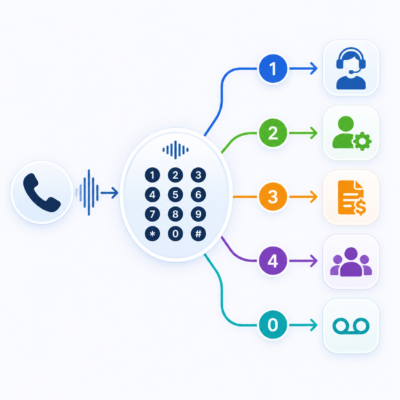
Rather than having one AI agent attempting to deal with every type of call, different AI agents can have different roles.
The first agent acts as your receptionist:
Answer
↓
Understand why they’re calling
↓
Deal with straightforward enquiries
↓
Triage the call
↓
Send it to the right destination
That destination could be a human or another specialist AI agent.
Imagine a Home Improvement Company
A caller says:
“I’d like a quote for replacing my windows.”
The receptionist identifies a sales enquiry and directs it to an:
AI Sales Agent
That agent could establish the type of property, number of windows, postcode, requirements and timescale, then potentially book an appointment.
Another caller says:
“You’ve already installed my windows and I’ve got a problem with one of the doors.”
That could go to an:
AI Customer Service Agent
Another says:
“I’ve got a question about my invoice.”
That could go to an:
AI Accounts Agent
So you potentially have:
Main Business Number
↓
AI Receptionist
↓
Sales AI / Customer Service AI / Accounts AI / Human Team
For a simple business, one AI receptionist may be enough. For a more complicated operation, specialist agents can have more focused roles.
And when human judgement is required, the call can be transferred to a person.
But Can HighLevel Replace a Proper Office Phone System?
AI is exciting, but the fundamentals still matter.
Most growing businesses need:
- A main business number
- Several people able to answer
- Internal call transfers
- Departments and call routing
- IVR
- Working-hours routing
- Voicemail
- Desktop and mobile calling
- Desk phones where required
- Call recording
- Remote working
- Out-of-hours handling
This is where HighLevel has developed significantly.
Several Employees Can Answer Business Calls
Incoming calls can be routed to team members and, depending upon the setup, answered through:
Web app
Mobile app
Telephone
SIP desk phone
So your receptionist might use a physical phone, an office manager their computer and a salesperson their mobile.
They’re all potentially part of the same business phone system.
Working-Hours Routing
HighLevel can take individual users’ working hours into account when routing inbound calls.
If somebody isn’t working, HighLevel can skip them and follow alternative routing.
That means:
During office hours
↓
Ring the team
and:
Outside office hours
↓
AI receptionist
This can also accommodate part-time staff, different working days and holidays.
Call Transfers and Internal Phones
HighLevel supports both blind and warm transfers.
A blind transfer sends the caller directly to another person.
A warm transfer lets you speak to the colleague first:
“I’ve got Mr Smith on the line about his quote. Are you free to take it?”
and then connect the customer.
Calls can be transferred to colleagues using their configured web, phone or SIP devices.
HighLevel also supports compatible SIP desk phones, so moving to HighLevel doesn’t mean everybody needs to sit at a computer wearing a headset.
You could have:
Receptionist on a desk phone
Office manager using the web app
Salesperson using mobile
Remote worker using a laptop
all working within the same overall phone environment.
Call Scripts Help Your Team Handle Calls Consistently
As your team grows, you don’t necessarily want every employee handling an important sales enquiry completely differently.
HighLevel supports Call Scripts within its web dialler.
For example, a sales script might remind the person handling the call to establish:
What service are you interested in?
Where are you based?
When are you looking to proceed?
What’s the best next step?
The aim isn’t to turn your team into robots.
It’s to make sure important questions don’t get forgotten.
Scripts could be useful for:
- New enquiries
- Sales qualification
- Appointment booking
- Quote follow-up
- Renewals
- Customer service
Then Record What Happened With Call Dispositions
At the end of the call, HighLevel’s Call Dispositions provide a structured way to record the outcome.
For example:
Follow Up
Requested Callback
Appointment Requested
Interested
Not Interested
But the really useful part is that a disposition can trigger automation.
For example:
Requested Callback
↓
Create follow-up task
Or:
Appointment Requested
↓
Send booking information
↓
Create task
Or:
Not Interested
↓
Update CRM
↓
Stop inappropriate follow-up
Instead of:
Employee finishes call → tries to remember what to do
you have:
Employee finishes call → selects outcome → HighLevel starts the appropriate next step
For an office manager or owner trying to create consistent processes across a growing team, that’s potentially very useful.
The Big Difference: The Phone System Is Inside the CRM
This is where HighLevel starts to look different from a standalone VoIP system.
When somebody calls, your team can potentially have access to:
- Who they are
- Their company
- Previous conversations
- Opportunities
- Appointments
- Notes
- Tasks
- Previous messages
You’re not simply answering a random telephone call.
You’re continuing an existing customer relationship.
Many modern VoIP systems advertise:
CRM integration.
HighLevel approaches the problem differently:
The phone system is already part of the CRM platform.
Calling sits alongside:
Contacts, Opportunities, Calendars, Conversations, Tasks, Workflows, Email, SMS, WhatsApp and AI.
That’s perhaps the biggest difference.
What Happens When Nobody Answers?
A conventional setup might look like:
Ring → Ring → Ring → Voicemail
HighLevel gives you other options.
One is Missed Call Text Back.
Someone calls, nobody answers and they immediately receive an SMS inviting them to reply.
That potential customer may have been about to call the next business on Google.
Or rather than letting the call become missed:
Voice AI can answer it.
The Call Can Trigger What Happens Next
Because the phone system sits inside HighLevel, the important question isn’t simply:
Did somebody call?
It’s:
What should happen because they called?
For example:
Salesperson handles enquiry
↓
Selects “Appointment Requested”
↓
Workflow starts
↓
Booking information sent
↓
Opportunity updated
Or:
AI receptionist handles enquiry
↓
Contact captured
↓
Appointment booked
↓
CRM updated
↓
Salesperson notified
↓
Confirmation sent
The telephone call becomes part of a wider business process.
Imagine This Happening at 8:45pm
A potential customer finds a home improvement company on Google.
It’s 8:45pm.
They call.
AI receptionist answers
↓
Identifies a new sales enquiry
↓
Routes to the appropriate AI sales process
↓
Enquiry qualified
↓
Contact details captured
↓
Appointment booked
↓
CRM updated
↓
Salesperson sees the qualified enquiry the following morning
The customer hasn’t left a voicemail and waited until tomorrow.
More importantly, they haven’t simply called the next company on Google.
They’ve interacted with your business.
That’s much more than simply replacing an office telephone.
Phone, SMS, WhatsApp and Email Around the Same Customer
Customers don’t think in communication channels.
Someone might call you, reply to an SMS later, send a WhatsApp message and eventually respond to an email.
HighLevel can bring much of that communication together around the same Contact.
That’s potentially much more useful than having:
Phone system in one place
CRM somewhere else
SMS elsewhere
WhatsApp somewhere else again
Is HighLevel Suitable for Every Business Phone System?
No.
If you’re operating a large contact centre with sophisticated queue management, workforce planning, specialist compliance requirements or hundreds of agents, a dedicated platform may still be the right answer.
But imagine an SME with 5, 10, 20 or 30 employees that needs:
- One main business number
- Several people answering
- Internal transfers
- Departments
- Remote workers
- Mobile users
- Desk phones
- Out-of-hours cover
- Call scripts
- Call outcomes
- CRM
- Follow-up automation
- AI receptionist
HighLevel becomes a serious option.
Don’t Just Compare the Phone Features
There may be individual telephony features where a specialist VoIP provider wins.
That’s to be expected.
The better question is:
What does the business actually need to happen when a customer calls?
If the telephone is one part of:
Sales, customer service, appointment booking, CRM, follow-up and automation
then HighLevel has an important advantage.
The phone system isn’t another application that needs integrating into your CRM. It’s already inside it.
Could It Save Money Too?
Potentially.
Many businesses already pay separately for:
- Business phone system
- CRM
- Email marketing
- SMS
- Appointment booking
- Marketing automation
- AI receptionist
So don’t just compare the monthly cost of the phone system.
Look at the total software stack.
If HighLevel can consolidate several of those systems, the economics can change considerably.
Voice AI also potentially gives an SME a level of telephone availability that would be expensive to provide using people alone.
My View
A few years ago, I would have thought of HighLevel’s phone functionality mainly as a useful extra within its CRM.
Today, I think that’s underselling it.
For many SMEs, HighLevel is becoming a credible alternative to a standalone small business phone system.
The most interesting part isn’t simply making and receiving calls.
It’s everything that happens around the call.
A standalone phone system knows somebody called.
HighLevel can potentially know:
Who called
What they wanted
What stage they’re at
What the outcome was
and:
What needs to happen next.
Then CRM, automation, SMS, WhatsApp, email, calendars and AI can take over.
And Voice AI introduces another question.
Instead of simply asking:
“Who is going to answer the phone?”
you can start asking:
“Which calls should our people answer, which can our AI receptionist handle and which could be passed to a specialist AI agent?”
So if your company has outgrown mobiles, simple call forwarding or a basic office telephone, don’t just compare traditional VoIP providers.
Ask a bigger question:
If our phone system was part of our CRM, automation and AI platform, what could we do differently?
For many SMEs, I think the answer is becoming very interesting.
To check out all the features of HighLevel please visit out HighLevel agency – MarketerM8.
Woudl you like a call to discuss your requirements in detail – Book a Discovery Call with Julian.

About the Author
Julian Mills
HighLevel Consultant & Marketing Automation Strategist
Julian Mills helps business owners automate lead generation, sales follow-up, customer communication and business processes using HighLevel and MarketerM8. Since 2009 he has helped businesses implement CRM, marketing automation and AI-powered systems that save time, improve customer experience and generate more sales.
About Julian
Book a Discovery Call
Join a Free HighLevel Workshop
Learn About HighLevel with MarketerM8