For a long time, if you’d asked me what HighLevel was particularly good at, my answer would have been fairly straightforward:
Marketing, lead generation, sales and follow-up.
It was excellent at capturing leads, nurturing them, booking appointments, managing sales opportunities and automating communication.
| Did you find this content useful? |
|---|
| Sign up for my free Marketing Hints, Tips and Hacks email newsletter every Tuesday at 11am. => Sign up here <= |
But once somebody became a customer, many businesses would still need another system to actually deliver the work.
That’s beginning to change.
HighLevel is evolving rapidly beyond marketing and sales. Increasingly, we’re seeing features that allow businesses to use HighLevel to help run their day-to-day operations.
One of the clearest examples of this is the rapid development of Custom Objects. HighLevel has expanded them across all plans, increased the number available per account and, importantly, integrated them much more deeply into workflows and automation.
But Custom Objects are only part of the story.
We’re also seeing more sophisticated operational automation, calculations, reporting, a growing App Marketplace, APIs and integrations, plus the beginnings of AI-assisted app development.
Put all of those developments together and I think we’re seeing something significant.
HighLevel started as a marketing platform. It developed into a sales and CRM platform. Now it’s increasingly becoming an operating hub around which an SME can run much more of its business.
From Marketing Platform to Business Operations Platform
HighLevel’s origins are obvious when you look at its traditional strengths.
It brings together:
- CRM
- Email marketing
- SMS
- Phone
- Calendars
- Forms
- Funnels
- Websites
- Sales pipelines
- Reviews
- Social media
- Payments
- Documents and contracts
- Marketing automation
- AI
That’s already an impressive collection of functionality.
But historically, much of it revolved around acquiring and converting customers.
The journey looked something like:
Lead → Follow-up → Appointment → Opportunity → Sale
But what happens after the sale?
For many businesses, that’s where things get much more complicated.
Imagine a home improvement company:
Sale → Survey → Project → Materials → Installation → Completion → Aftercare
An insurance broker:
Client → Policy → Renewal → Claim → Policy Change
A garage:
Customer → Vehicle → Service → MOT → Repair → Next Service
An estate agent:
Contact → Property → Viewing → Offer → Transaction → Completion
These are operational processes rather than simply marketing processes.
Historically, businesses would often need another piece of software to manage them.
HighLevel is increasingly building the infrastructure that could allow more of these processes to be managed within, or around, the CRM.
Custom Objects Are a Big Part of This Change
Most CRMs contain standard types of records.
HighLevel has traditionally revolved primarily around Contacts, Companies and Opportunities.
A Custom Object lets you create another type of record specific to your business.
Imagine you run a garage.
You don’t really want all the information about someone’s car stored against the customer’s Contact record.
A customer might own several vehicles.
Instead, you could create:
Custom Object: Vehicle
Each vehicle could then have information such as:
- Registration number
- Make
- Model
- Year
- VIN
- Mileage
- MOT date
- Last service date
- Next service date
- Warranty information
The Vehicle is then associated with the customer.
One customer can have multiple vehicles.
That’s fundamentally different from simply adding more custom fields to a Contact.
You’re beginning to build a data model of how the business actually operates.
HighLevel Has Made Custom Objects Much More Accessible
This is particularly relevant now because HighLevel has significantly expanded Custom Objects.
They are no longer restricted to the Pro plan. HighLevel has made them available across Starter, Unlimited and Pro plans.
HighLevel has also increased the maximum number of Custom Objects in an account from 3 to 10.
HighLevel itself gives examples including:
Properties, Policies, Loans, Patients, Vehicles and Projects.
Those examples are revealing.
These aren’t simply marketing records.
They’re operational business records.
Why Relationships Between Records Matter
Take an insurance broker.
You might have:
Contact: John Smith
John could then be associated with:
Motor Policy
Home Policy
Business Policy
Each policy exists independently and has its own:
Policy number
Insurer
Premium
Start date
Renewal date
Status
That’s considerably cleaner than creating dozens of custom fields against John Smith’s Contact record and then wondering what happens when he buys a second policy.
Custom Objects allow the CRM to start reflecting the actual relationships within the business.
But Storing Operational Data Isn’t Enough
This is where the recent HighLevel developments become particularly interesting.
It’s one thing to store a Project inside your CRM.
It’s another thing for HighLevel to understand:
The project has been created.
The installation date has changed.
A milestone has been completed.
The renewal date is approaching.
The service job has changed status.
And then automatically take action.
That’s where HighLevel’s workflows become particularly powerful.
Custom Objects can now have their own workflows.
Instead of automation always being triggered because something has happened to a Contact, it can happen because something has changed with a:
Project
Property
Vehicle
Policy
Service Job
or whatever other Custom Object you’ve created.
That’s an important shift from marketing automation towards business process automation.
Imagine Running a Project Through HighLevel
Let’s use a home improvement business as an example.
A salesperson marks an Opportunity as Won.
A workflow could automatically create a new:
Project
record associated with the customer.
That Project might contain:
Customer
Property
Project value
Survey date
Installation date
Project manager
Installation team
Materials cost
Status
Completion date
As the project progresses, workflows could react to changes.
Project created
→ Create internal tasks
Survey date approaching
→ Send customer reminder
Survey completed
→ Update project status
Installation date approaching
→ Notify customer
Installation completed
→ Begin aftercare
Project completed
→ Request review
Six months later
→ Customer follow-up
Now we’re well beyond lead nurturing.
We’re using HighLevel to help deliver the service.
HighLevel Can Find and Update Operational Records Automatically
Another useful development is Find Object Record.
A workflow can search for an existing Custom Object based upon information such as an external ID or VIN, then update, associate or branch the automation depending upon whether the record was found.
Imagine another system sends HighLevel information about:
Vehicle Registration: AB12 CDE
HighLevel can look for the corresponding Vehicle record.
If it exists:
Update it.
If it doesn’t:
Take a different route and potentially create it.
This becomes particularly interesting when HighLevel is being used alongside other business systems.
And that brings me to an important point.
HighLevel Doesn’t Have to Do Everything
I don’t think HighLevel becoming more operational means every other piece of specialist software suddenly becomes unnecessary.
Quite the opposite.
There will always be specialist applications that do particular jobs better.
An accountant will still need accounts production software.
A solicitor may need specialist legal practice management software.
A garage may need workshop software.
A construction company might require sophisticated project or job management software.
HighLevel doesn’t necessarily need to replace those applications.
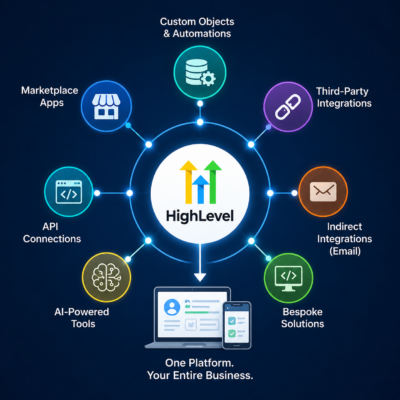
Instead, I think HighLevel can increasingly become the central CRM, automation and communications hub around them.
And there are now several ways of achieving that.
Five Ways to Extend HighLevel Into Business Operations
If your business has an operational requirement, I’d approach it in roughly the following order.
1. Use HighLevel’s Native Functionality
Always start here.
If HighLevel already does what you need, there’s little point introducing another application unnecessarily.
HighLevel already covers an enormous amount of ground.
The simplest solution is often the best one.
2. Extend HighLevel Using Custom Objects and Automation
If your business needs to manage something beyond Contacts, Companies and Opportunities, you may be able to model it using Custom Objects.
That might be:
Projects
Properties
Vehicles
Policies
Service Jobs
Contracts
You can then build HighLevel workflows, tasks, reminders, calculations and reporting around those records.
For some SMEs, that may be enough to bring an operational process directly into HighLevel without introducing another platform.
3. Install a Specialist HighLevel Marketplace Application
If HighLevel doesn’t provide the specialist functionality you require, the next place I’d look is the HighLevel App Marketplace.
This is an important part of the bigger picture.
HighLevel doesn’t need to develop every specialist feature required by every type of business.
Marketplace developers can extend the platform.
A good example of this approach is FieldTask.
FieldTask has been designed to work alongside HighLevel for businesses that need to manage service delivery and jobs once the sale has been made.
HighLevel might manage:
Lead → Follow-up → Quote → Opportunity → Customer
Then FieldTask extends that into:
Job → Scheduling → Team → Service Delivery → Completion
HighLevel can remain at the centre for CRM, sales, automation and customer communication, while the specialist application handles the operational requirements it was designed for.
I’ve written about this separately here:
FieldTask for HighLevel: What It Is, How It Works and How to Get It
This is a good illustration of something I think will become increasingly important.
HighLevel doesn’t have to build absolutely everything itself.
It can become the platform around which an ecosystem of specialist applications develops.
4. Connect HighLevel to an Existing Third-Party System
There’s another option that shouldn’t be overlooked.
You may already have specialist software that does its job extremely well.
If that’s the case:
Why replace it?
Instead, connect it to HighLevel.
Platforms such as Zapier, Make and Pabbly Connect can act as the bridge between HighLevel and thousands of other applications.
For example, something happens inside your specialist operational system.
That information gets passed to HighLevel.
HighLevel can then:
Update the CRM
↓
Update an Opportunity or Custom Object
↓
Trigger a workflow
↓
Send an email, SMS or WhatsApp message
↓
Create a task
↓
Notify the appropriate team member
Information can potentially travel in the opposite direction too.
Something happening inside HighLevel could trigger an action in the specialist system.
This means the specialist application can continue doing what it does best, while HighLevel manages the CRM, communication, marketing and automation around it.
The Problem With Some Older Industry-Specific Software
There is, however, a problem I come across with some of the older, longer-established software platforms used within particular industries.
They weren’t necessarily designed for today’s interconnected software environment.
You might discover that the system has:
No Zapier integration
No Make integration
No Pabbly integration
and, more importantly:
No accessible API
If the software doesn’t provide a way of getting data in or out, even an API developer may not be able to create a direct integration.
At first sight, that can look like the end of the road.
But sometimes there’s another option.
How to Create an Indirect HighLevel Integration Using Email with a Third Party Tool
Many older systems may not have modern integration capabilities, but they do send emails.
For example, imagine a specialist practice management system used by a clinic.
Whenever a new patient is created, the software sends an email notification containing information such as:
Patient name
Email address
Telephone number
Appointment details
The software may not integrate with Zapier.
It may not have an API.
But if that notification email can be diverted or forwarded to something such as Zapier Email Parser, we may be able to extract the relevant information from the email.
The process could look like:
New patient created in specialist software
↓
Specialist software sends notification email
↓
Email is forwarded to an email parser
↓
Patient information is extracted
↓
Zapier receives the structured data
↓
Contact is created or updated in HighLevel
↓
HighLevel workflow begins
Suddenly we’ve created an indirect integration with a piece of software that technically doesn’t integrate with HighLevel at all.
HighLevel could then take over the communication process.
For example:
Send appointment information
↓
Send SMS or WhatsApp reminders
↓
Start an onboarding sequence
↓
Create internal tasks
↓
Request a review after the appointment
The original specialist system continues doing the job it was designed for.
HighLevel handles the customer communication and automation around it.
It’s Not Limited to New Customers
The same principle can potentially work with other notification emails.
An older system might send an email when:
- A new customer is created
- An appointment is booked
- A job changes status
- A policy is approaching renewal
- A payment is received
- A service is completed
- A case reaches a particular stage
If the notification contains consistent, identifiable information, there may be an opportunity to extract that information and use it to trigger activity within HighLevel.
It’s not as elegant as a proper API integration.
And it won’t work in every situation.
The email needs to contain the required information in a sufficiently consistent format, and you need to think carefully about data protection and the reliability of the process, particularly where sensitive customer information is involved.
But where the alternative is no integration at all, it can be a remarkably useful workaround.
It also demonstrates why I don’t immediately accept:
“Our existing software doesn’t integrate with HighLevel.”
as the end of the conversation.
The better question is:
“What information can we get out of the existing system, and how can we get it into HighLevel?”
Sometimes there’s a route that isn’t immediately obvious.
When Zapier, Make or Pabbly Aren’t Enough
If the software does provide an API, but there isn’t a ready-made Zapier, Make or Pabbly integration, that’s another situation entirely.
An API developer may be able to create a direct connection between the two systems.
This can be more involved and expensive than using an off-the-shelf integration, but it’s still very different from developing an entirely new software application.
You’re not reinventing the specialist software.
You’re simply building the bridge between two existing systems.
For the right requirement, that can be a very sensible approach.
So I’d broadly think of third-party integration in three levels:
Ready-made integration
Use Zapier, Make, Pabbly or an existing connector.
↓
Direct API integration
Have a developer connect the systems where APIs are available.
↓
Indirect integration
Where the older system is effectively closed, look for other reliable outputs, such as notification emails, that can potentially be captured and passed into HighLevel.
Sometimes the most useful integration isn’t actually an integration in the traditional sense.
It’s simply finding a reliable way of getting the right information from System A into HighLevel at the right moment.
5. Build Something Bespoke
Finally, there’s the option of developing functionality specifically for your business.
HighLevel has an increasingly capable API and developer ecosystem.
So, in theory, if your business has a very particular requirement, you can create your own software or application around HighLevel.
But I would put a big word of caution around this option.
There is a major difference between integrating existing software and becoming responsible for your own software.
Bespoke software needs to be:
Designed
Developed
Tested
Secured
Hosted
Monitored
Documented
Maintained
Updated
and supported when something inevitably goes wrong.
The important question isn’t simply:
“How much will this cost us to build?”
It’s:
“Who is going to maintain this for the next five years?”
If your business becomes dependent upon that software, you’ve effectively created another software product that somebody needs to look after.
There can absolutely be a business case for doing this.
But it should be approached seriously.
AI Is Creating an Interesting Middle Ground
There is one area where I think the economics of bespoke development are beginning to change.
AI-assisted development tools such as Lovable, together with HighLevel’s rapidly evolving AI Studio, are making it possible to create relatively simple tools much faster than would traditionally have been possible.
That could make sense for things such as:
- Calculators
- Internal dashboards
- Simple quoting tools
- Data collection interfaces
- Customer information tools
- Lead generation tools and quizzes
- Small utilities that interact with HighLevel data
I’ve experimented with this myself.
For example, I’ve used Lovable to create a front-end experience and then connected it to HighLevel using a webhook. HighLevel can then take over the CRM, automation and follow-up.
I’ve written in more detail about the relative strengths of the two approaches here:
How Do HighLevel AI Studio and Lovable Compare?
This is an area I expect to develop very quickly.
But there’s an important distinction I would make:
How business-critical is the application?
If an AI-built calculator or useful internal tool stops working for an afternoon, that’s inconvenient.
If the application controls every job, payment, engineer schedule and customer record in your company, that’s a completely different level of risk.
I’m quite comfortable with the idea of using AI-assisted development for useful, relatively simple and non-business-critical tools.
I’d be much more cautious about building an entire service-delivery operation around something quickly created with an AI app builder.
AI may dramatically reduce the time and technical knowledge required to build the first version of an application.
It doesn’t remove the need for:
- Security
- Testing
- Data protection
- Backups
- Documentation
- Maintenance
- Technical ownership
The technology might make it easier to build version one.
Someone still needs to be responsible for versions two, three, four and five.
A Sensible Order of Preference
So, if I were looking at an operational requirement within a business using HighLevel, I’d generally ask these questions in this order:
1. Can HighLevel already do it?
↓
2. Can we build it using HighLevel’s Custom Objects, workflows and other native functionality?
↓
3. Is there a proven HighLevel Marketplace application that already does it?
↓
4. Can we integrate an existing specialist application using Zapier, Make, Pabbly, an API connection or even an indirect integration?
↓
5. Do we genuinely need to build something bespoke?
That final question matters.
Just because it’s becoming easier to build software doesn’t necessarily mean building software is the best business decision.
Sometimes the smartest technology decision is simply getting two proven systems to talk to each other.
The Marketplace Makes the Platform Model Even More Interesting
I think the development of HighLevel’s Marketplace deserves particular attention.
A mature business platform doesn’t need its core developers to build every possible feature.
Look at platforms such as Shopify.
Part of their power comes from the ecosystem around the core platform.
We’re beginning to see signs of HighLevel moving further in that direction.
If businesses are going to rely on Marketplace applications operationally, those apps need to behave more like proper maintained software products.
HighLevel is increasingly building the infrastructure around that ecosystem.
Operational Reporting Is Starting to Appear Too
If you’re going to manage operational processes through HighLevel, you also need to know what’s happening.
Custom Object data can increasingly be incorporated into HighLevel’s reporting.
Imagine you’ve created a Project object.
You might want to report on:
Projects currently open
Projects completed
Total project value
Average project value
An insurance business might want information about:
Policies
Policy values
Claims
A garage might be interested in:
Vehicles
Service orders
Average service value
Again, this is a very different use of HighLevel from simply reporting on leads and sales opportunities.
Even Calculations Can Become Part of the Process
HighLevel is also expanding the actions that can be performed within these operational workflows.
For example, calculations can be incorporated into Custom Object workflows.
Imagine a Project containing:
Material cost: £4,000
Labour cost: £2,500
The workflow could calculate:
Total project cost: £6,500
Individually, that’s not revolutionary.
But step back and look at what we’re accumulating:
Custom business records
Relationships
Tasks
Dates
Calculations
Automations
AI
Reporting
Marketplace applications
Third-party integrations
APIs
Bespoke applications
Individually these are product features.
Collectively they suggest something much bigger.
Is HighLevel Now a Project Management or Job Management System?
I’d be careful here.
I wouldn’t currently position HighLevel as a replacement for every dedicated project management or job management platform.
If you require sophisticated resource scheduling, inventory management, field service functionality, complex project dependencies or industry-specific functionality, a specialist application may still be the right answer.
But the boundary is shifting.
There are plenty of SMEs whose operational requirements aren’t particularly complicated.
They need to know:
What jobs do we have?
Who is responsible?
What’s the status?
What’s happening next?
When is it due?
Does the customer need updating?
Has somebody completed the task?
What happens when it’s finished?
Increasingly, HighLevel can either handle those sorts of processes itself or sit at the centre of the systems that do.
And I think that’s the more important development.
HighLevel as the Operating Hub
This changes how I think businesses should evaluate HighLevel.
Rather than asking:
“Does HighLevel do absolutely everything our business needs?”
I’d ask:
“Could HighLevel become the operating hub of our business, with specialist applications extending it where required?”
That’s a much more interesting proposition.
You could potentially have:
HighLevel native functionality
↓
Custom Objects and workflows
↓
Marketplace applications such as FieldTask
↓
Existing specialist software connected through Zapier, Make or Pabbly
↓
Indirect integrations where older software doesn’t provide modern integration options
↓
Direct API integrations where necessary
↓
Lightweight AI-built tools
↓
Bespoke software where genuinely justified
all organised around the same CRM and customer journey.
The result isn’t necessarily one piece of software that does everything.
It could be something better.
One central platform around which the rest of the business technology is organised.
So Is HighLevel Becoming a Replacement for Salesforce or HubSpot?
Not necessarily.
Platforms such as Salesforce have spent decades developing extremely sophisticated CRM, data, reporting, permissions and enterprise capabilities.
HighLevel isn’t suddenly Salesforce.
Nor does having Custom Objects automatically mean every business should use them.
There’s no point making a CRM more complicated simply because you can.
But for the SME market, I think something interesting is happening.
The question used to be:
“Is HighLevel’s CRM sophisticated enough for our sales and marketing?”
Increasingly, I think the question is becoming:
“How much of our entire business could we run through HighLevel?”
That’s a very different conversation.
My View
I’ve worked with CRM and marketing automation platforms for many years, and one thing I’ve learned is that adding more features doesn’t automatically make software better.
Sometimes it simply makes it more complicated.
What interests me about the direction HighLevel is taking is that many of these developments connect together.
Custom Objects allow us to model the things a business actually manages.
Associations connect those things to customers, companies and opportunities.
Workflows automate the processes around them.
Dates can trigger operational activity.
Tasks allow people to manage the work.
Reporting provides visibility.
HighLevel’s existing email, SMS, WhatsApp, phone and AI capabilities provide the communication layer.
The Marketplace allows specialist developers to extend the platform.
Zapier, Make, Pabbly and APIs allow existing third-party systems to be connected.
Even older, relatively closed software can sometimes be brought into the picture through indirect integrations.
And AI-assisted development is starting to make smaller bespoke tools more accessible.
That’s potentially very powerful.
HighLevel started life with a strong marketing focus.
It then developed into a much broader sales and CRM platform.
I think we’re now seeing the beginning of its next evolution: HighLevel as the operating hub of the business.
It’s not there for every business and every use case yet.
There will still be many situations where specialist software is the right answer.
But HighLevel is evolving remarkably quickly.
And if you’re currently considering HighLevel, I’d suggest looking beyond the question of which marketing tools it could replace.
The much more interesting question may now be:
How much of the day-to-day running of your business could HighLevel bring together in one place?

About the Author
Julian Mills
HighLevel Consultant & Marketing Automation Strategist
Julian Mills helps business owners automate lead generation, sales follow-up, customer communication and business processes using HighLevel and MarketerM8. Since 2009 he has helped businesses implement CRM, marketing automation and AI-powered systems that save time, improve customer experience and generate more sales.
About Julian
Book a Discovery Call
Join a Free HighLevel Workshop
Learn About HighLevel with MarketerM8

