If you spend time working with small and medium-sized businesses preparing for acquisition, succession, management buyouts, or eventual exit, you will already know this:
Most businesses are far less organised than they appear on the surface.
At first glance, the revenue may look healthy. The business may have a strong reputation, loyal customers, and a solid track record.
But once you start looking behind the scenes, the cracks often appear quickly:
| Did you find this content useful? |
|---|
| Sign up for my free Marketing Hints, Tips and Hacks email newsletter every Tuesday at 11am. => Sign up here <= |
- Customer data spread across multiple systems
- Sales processes living inside the owner’s head
- No visibility of lead follow-up
- Team communication fragmented across email, WhatsApp, phones, and notebooks
- Poor reporting
- Inconsistent onboarding
- No automation
- No documented workflows
- Founder dependency everywhere
For buyers, these are red flags.
And for consultants helping businesses prepare for sale, these operational weaknesses can directly impact valuation, buyer confidence, and deal attractiveness.
This is one of the reasons more consultants are now introducing CRM and marketing automation systems much earlier in the business improvement process.
Increasingly, many are turning to HighLevel as part of that operational infrastructure.
Buyers Want Systems, Not Chaos
One of the biggest misconceptions amongst business owners is that buyers simply purchase revenue.
They do not.
Buyers purchase:
- Systems
- Predictability
- Visibility
- Transferability
- Operational maturity
- Recurring revenue
- Customer relationships
- Documented processes
A business that depends entirely on the founder is inherently risky.
If the owner is:
- Handling all sales
- Answering all calls
- Remembering all customer history
- Manually chasing leads
- Managing workflows from memory
Then the business becomes difficult to transfer to a new owner.
This is where structured CRM and automation systems become commercially valuable.
They help transform businesses from person-dependent into system-dependent.
That transition can significantly improve scalability, operational efficiency, and buyer confidence.
Why CRM and Automation Are Becoming Part of Exit Planning
Historically, many businesses viewed CRM systems purely as sales tools.
Today, modern CRM and automation platforms have evolved into something much bigger.
They are now:
- Operational hubs
- Communications systems
- Customer intelligence platforms
- Workflow engines
- AI infrastructure layers
For consultants helping businesses prepare for growth or exit, this matters enormously.
Because when implemented correctly, these systems create:
- Consistency
- Accountability
- Visibility
- Documented processes
- Operational continuity
All of which become valuable during due diligence.
Why HighLevel Fits Particularly Well Into This Space
Many CRM systems are designed primarily for enterprise sales teams.
HighLevel is different.
It combines:
- CRM
- Marketing automation
- Pipelines
- Communication tools
- Websites
- Funnels
- Calendars
- Reputation management
- AI tools
- Reporting
- Workflow automation
Inside one connected ecosystem.
For SMEs, that consolidation can be transformational.
Instead of businesses operating across:
- Spreadsheets
- Separate email platforms
- Disconnected calendars
- Multiple marketing tools
- Scattered communication apps
They can centralise much of the business operation into one platform.
This creates cleaner systems, better visibility, and far more transferable operational processes.
Why Many Consultants Are Looking Beyond Traditional CRM Platforms
Traditionally, when businesses started looking at CRM and operational systems, the obvious enterprise choices were platforms like Salesforce and HubSpot.
Both are powerful systems and widely used across larger organisations.
However, for many SMEs preparing for growth or sale, these platforms can quickly become:
- Expensive
- Complex
- Fragmented
- Consultant-heavy
- Difficult to fully implement internally
It is not uncommon for businesses to invest heavily in CRM software, only to end up using a small percentage of the functionality because the implementation becomes overwhelming.
This is one reason many consultants are now exploring more modern, integrated platforms like HighLevel.
Rather than stitching together multiple systems, HighLevel combines:
- CRM
- Marketing automation
- Pipelines
- Websites
- Funnels
- Calendars
- Communication tools
- Reputation management
- AI functionality
- Workflow automation
Inside one connected platform.
Importantly, businesses do not necessarily need to make an overnight switch.
HighLevel now includes tools that allow it to work alongside systems such as HubSpot during transition periods, helping businesses gradually centralise operations without immediately disrupting existing workflows.
For businesses ready to fully consolidate systems, HighLevel also offers import and migration tools that can help move contacts, pipelines, workflows, and operational processes directly into the platform.
For consultants helping businesses prepare for sale, this creates an interesting middle ground:
- Improve operational maturity
- Centralise systems
- Reduce fragmentation
- Introduce automation
- Improve visibility
Without necessarily forcing clients into complex enterprise-level implementations from day one.
Reducing Founder Dependency
One of the biggest valuation killers in SME acquisitions is founder dependency.
It is extremely common to find businesses where:
- Customer relationships exist only on the owner’s mobile phone
- Sales conversations are buried in personal inboxes
- Staff cannot see communication history
- No one else understands the sales pipeline
- Lead follow-up is inconsistent
- Customer onboarding varies every time
This creates risk for buyers.
HighLevel helps reduce this risk by centralising communication and operational workflows.
For example:
- Email conversations
- SMS messages
- Phone call recordings
- Facebook messages
- Instagram messages
- WhatsApp conversations
Can all be viewed within the Universal Inbox in chronological order.
This creates continuity across teams and reduces reliance on one individual holding all the information.
From an acquisition perspective, this is extremely valuable.
Automation Creates Operational Consistency
Another major challenge in many SMEs is inconsistency.
Without systems:
- Leads are missed
- Follow-up varies
- Onboarding becomes reactive
- Customer communication depends on staff memory
Automation helps standardise these processes.
Examples include:
- Automated lead nurturing
- Missed call text back workflows
- Appointment reminders
- Onboarding sequences
- Review request campaigns
- Reactivation campaigns
- Internal task notifications
- AI-assisted customer communication
These systems help businesses become more process-driven and less reactive.
Again, this improves scalability and operational maturity.
A Modern Example. AI Receptionists and AI-Powered Customer Support
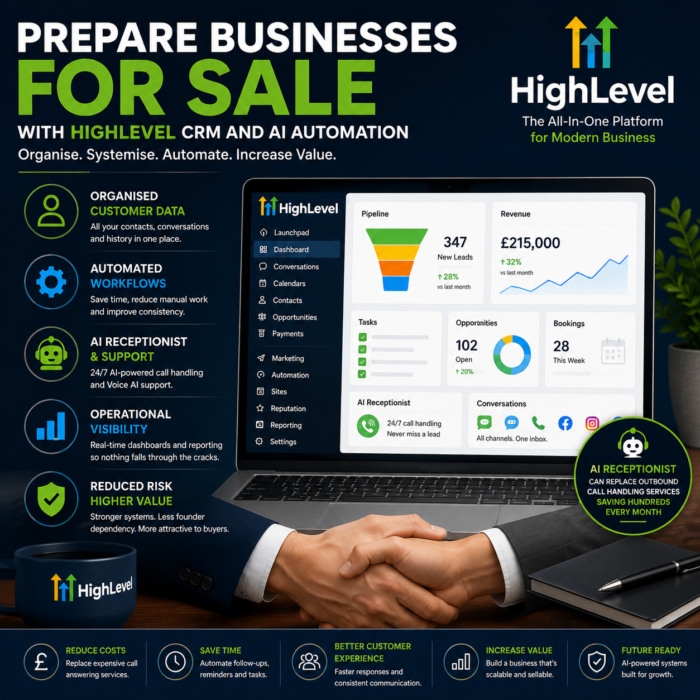
A good modern example of how HighLevel can help organise and systemise a small business is through the introduction of AI-powered phone answering and customer support using Voice AI.
Many small businesses still rely heavily on:
- Missed calls
- Voicemail
- Staff remembering to call people back
- Fragmented customer communication
- Handwritten notes
- Reactive support processes
This creates inefficiency and operational risk.
It also creates founder dependency, where key customer communication only exists inside one person’s phone or memory.
Using HighLevel’s Voice AI tools, businesses can introduce an AI receptionist that answers inbound calls 24/7.
For example, an AI receptionist can:
- Answer common questions
- Capture lead information
- Qualify enquiries
- Book appointments directly into calendars
- Route calls to the correct team member
- Log conversations automatically into the CRM
- Trigger follow-up workflows
- Summarise calls for staff review
- Handle overflow and out-of-hours enquiries
This immediately creates more structure and consistency inside the business.
Instead of enquiries being missed or handled inconsistently, every interaction becomes:
- Logged
- Searchable
- Trackable
- Visible to the wider team
The same applies to technical support.
A small business can use Voice AI alongside automation workflows to:
- Categorise support enquiries
- Answer repetitive questions
- Route urgent issues
- Create tickets or tasks
- Update customer records automatically
- Maintain communication history centrally
Over time, this creates operational intelligence inside the business rather than relying on individual staff members remembering what happened previously.
From a business sale perspective, this is valuable because buyers can see:
- Documented communication processes
- Customer interaction history
- Response systems
- Operational workflows
- Reduced key person dependency
- Scalable support infrastructure
It demonstrates that the business operates through systems rather than memory.
There can also be a direct financial benefit.
Many SMEs currently use outsourced call answering or telephone handling services that can cost hundreds of pounds per month, particularly once call volumes increase.
In some cases, introducing an AI receptionist through HighLevel can partially or fully replace these services while also providing:
- CRM integration
- Automated follow-up
- Conversation logging
- Appointment booking
- Workflow automation
- AI-supported customer communication
For some businesses, that saving alone can cover a significant portion, or even all, of the monthly HighLevel subscription cost.
For many SMEs, this is one of the first practical examples of AI genuinely improving operational efficiency rather than simply being a marketing buzzword.
AI Is Now Entering the Conversation
Increasingly, consultants are also exploring how AI fits into business infrastructure.
This is another reason HighLevel is gaining attention.
Features such as:
- AI conversational tools
- AI chat
- AI workflow support
- AI voice systems
- AI receptionists
Allow businesses to automate and support customer communication at scale.
For many SMEs, this is the first realistic opportunity to introduce AI into day-to-day operations without building expensive custom systems.
This is why many people are now beginning to describe HighLevel as:
The AI Operating System for SMEs.
Not because it replaces every specialist tool, but because it increasingly acts as the central operational layer connecting communication, marketing, automation, and customer management together.
The Opportunity for Exit Planning Consultants and Operational Advisors
There is also a growing opportunity here for:
- Exit planning consultants
- EOS implementers
- Business coaches
- Operational consultants
- Fractional COOs
- M&A advisors
Many understand the importance of systems and operational maturity, but do not necessarily want to become CRM implementation specialists themselves.
That creates a natural partnership opportunity with experienced HighLevel consultants who can implement the technical infrastructure behind the strategic recommendations.
Instead of simply advising businesses to “improve systems”, consultants can now help clients introduce:
- Structured pipelines
- Operational dashboards
- Automation
- AI-supported communication
- Documented onboarding
- Centralised customer management
In practical, measurable ways.
The Future of Sellable Businesses
As AI, automation, and operational visibility become more important, buyers are increasingly expecting businesses to have mature systems already in place.
The days of running growing businesses entirely from spreadsheets, inboxes, and memory are disappearing.
Businesses with:
- Clean systems
- Centralised customer data
- Documented processes
- Automation
- Visibility
- Recurring operational workflows
Are simply becoming more attractive acquisitions.
For consultants helping businesses prepare for growth, succession, or exit, CRM and automation are no longer optional operational tools.
They are becoming part of the value-building process itself.
Written by Julian Mills – HighLevel consultant and marketing strategist.
About Julian Mills
Book a Discovery Call with Julian
Learn more about HighLevel and the MarketerM8 platform at MarketerM8.com.
Join the free weekly HighLevel workshops at MarketerM8 Workshops.

