For years, HubSpot has been one of the best-known CRM systems in the world.
And honestly, that made complete sense.
HubSpot solved a huge problem for small businesses.
“Get started with a free CRM.”
It was a brilliant offer.
Businesses could organise contacts, track deals, manage pipelines and start bringing some structure into the sales process without needing a massive software budget.
| Did you find this content useful? |
|---|
| Sign up for my free Marketing Hints, Tips and Hacks email newsletter every Tuesday at 11am. => Sign up here <= |
For many SMEs, HubSpot became their first “proper” CRM system.
But over the years I have noticed a very common pattern.
Businesses sign up to the free CRM.
They like it.
The team gets comfortable using it.
The pipeline works nicely.
Then gradually the business wants to do more.
And this is where many businesses begin researching how to migrate from HubSpot to HighLevel.
Not because HubSpot is bad.
Far from it.
But because growing businesses eventually want:
- more automation
- AI functionality
- SMS marketing
- social media scheduling
- funnel building
- Voice AI
- lead nurturing
- centralised communication
- appointment booking
- more users
- more flexibility
And this is often the point where software costs can begin escalating quickly.
At the same time, HighLevel has been growing extremely quickly.
Originally known mainly as a platform for agencies, HighLevel has evolved into something much bigger.
Increasingly, businesses are using HighLevel as:
- an AI Operating System for SMEs
- the “WordPress of CRM systems”
- an all-in-one marketing and communication platform
- a central business automation ecosystem
But there has always been one obvious question if you are already established on HubSpot.
How difficult is it to move everything?
As of August 2026, the answer to that question has changed significantly.
NEW: HighLevel Can Now Import Directly From HubSpot
This is a major development for anybody considering moving from HubSpot to HighLevel.
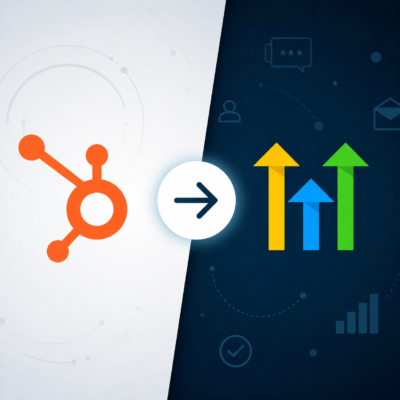
HighLevel has introduced a native HubSpot Importer.
Rather than exporting multiple CSV files from HubSpot, preparing the data, importing it into HighLevel and manually trying to recreate the relationships between everything, you can now connect your HubSpot account directly to HighLevel.
And importantly, this isn’t limited to importing a basic contact list.
HighLevel can now import:
- Contacts
- Companies
- HubSpot Deals as HighLevel Opportunities
- Contact properties as Custom Fields
- Company properties as Custom Fields
- Deal properties as Custom Fields
- Pipelines and stages
- Notes
- Emails
- Tasks
- Supported associations between records
That last point is particularly important.
A CRM isn’t simply a spreadsheet containing names and email addresses.
The real value is often in the history, relationships, opportunities, notes, tasks and information surrounding those contacts.
Being able to bring more of that structure across makes moving from HubSpot to HighLevel considerably more practical.
How to Import HubSpot Data Directly Into HighLevel
The new process is surprisingly straightforward.
Inside HighLevel, go to:
Contacts, Companies or Opportunities → Import
You can then select:
Connect HubSpot
HighLevel will ask you to sign into your HubSpot account.
From there you can choose which objects and information you want to migrate.
You can review the number of records that will be imported and select specific properties where required.
Once you’re happy, confirm the import.
The migration then runs in the background.
You Can Check What Has and Hasn’t Imported
This is another important part of the new importer.
HighLevel provides an Import History area where you can monitor the migration and see what happened.
You can see records that were:
- successfully imported
- skipped
- imported with warnings
- unsuccessful
You can also review the results by individual record or object, filter by status and see error messages explaining problems that occurred.
The results can also be downloaded as a CSV for further checking.
For anyone who has previously managed a CRM migration, this matters.
You don’t simply want HighLevel to tell you:
“Import complete.”
You need to know whether the 4,000 contacts you expected to migrate actually arrived and whether important records failed along the way.
A Few Important Things to Know Before You Import
The new importer makes the technical migration considerably easier, but there are still some important points to understand.
Firstly, existing matching records in HighLevel are not overwritten.
Secondly, HubSpot emails brought into HighLevel are imported as read-only records.
Thirdly, if you want HubSpot Deals to become HighLevel Opportunities, the associated contacts need to be imported as well.
And finally, HighLevel itself recommends testing your HubSpot import in a new or non-production sub-account first.
I strongly agree with that last point.
I wouldn’t recommend connecting a substantial HubSpot database to an established live HighLevel account and simply pressing the button to see what happens.
Test first.
Check your data.
Understand how your HubSpot structure maps into HighLevel.
Then plan the live migration.
Migrating the Data Is Only Part of Moving From HubSpot to HighLevel
This is perhaps the most important point in this article.
Importing your HubSpot data is not the same thing as migrating your business from HubSpot to HighLevel.
The new importer solves a big part of the data migration problem.
But there may still be lots of things to consider.
For example:
- What HubSpot automations need recreating as HighLevel Workflows?
- What forms are currently being used?
- What landing pages need rebuilding?
- What appointment calendars are connected?
- What email templates need recreating?
- What integrations are currently connected to HubSpot?
- How are leads being assigned?
- What reports does management rely upon?
- What happens when a new lead enters the system?
- What happens when a Deal changes stage?
- Are there any Zapier or Make integrations?
- Which HubSpot functionality do you actually still need?
This is why I don’t normally recommend treating a CRM migration as a simple lift and shift exercise.
It is actually an opportunity.
You’re changing the system.
So before rebuilding everything exactly as it was, ask:
Does it still need to work that way?
There may be workflows that haven’t been used for three years.
There may be custom properties nobody understands.
There may be old pipelines that are no longer relevant.
And there may be processes that required several pieces of software with HubSpot that can now be handled natively inside HighLevel.
Use the migration as an opportunity to simplify.
A Sensible HubSpot to HighLevel Migration Process
If I were planning a HubSpot to HighLevel migration today, I would break it into stages.
Step 1: Audit Your Existing HubSpot Account
Before touching anything, understand what you actually have.
Look at your:
- contacts
- companies
- deals
- pipelines
- properties
- forms
- workflows
- emails
- landing pages
- integrations
- calendars
- reporting
- users
Separate what you genuinely use from historical clutter.
Step 2: Design Your HighLevel Account
Don’t start importing data into an empty HighLevel account without thinking about the destination.
Decide how your HighLevel account needs to operate.
What pipelines do you need?
What custom fields matter?
What automations will you build?
What calendars are required?
Who needs access?
What communication channels will you use?
Step 3: Run a Test HubSpot Import
Use HighLevel’s new HubSpot Importer in a test or non-production account.
Import a representative sample where possible and check the results carefully.
Pay particular attention to:
- Contacts
- Companies
- Opportunities
- Pipelines
- Custom Fields
- Notes
- Tasks
- Emails
- Associations
Check whether the information appears where you expect it to appear.
Step 4: Build Your HighLevel Processes
Now recreate or, preferably, improve the processes that currently exist inside HubSpot.
This could include:
- sales pipelines
- automated follow-up
- appointment reminders
- lead nurturing
- missed-call text back
- forms
- surveys
- email campaigns
- SMS
- review requests
- Voice AI
- Conversation AI
This is where you can start taking advantage of functionality you may not previously have been using.
Step 5: Test the Complete Customer Journey
Don’t just test whether the contact exists.
Test what happens next.
Submit an enquiry.
Book an appointment.
Reply to an email.
Move an Opportunity.
Complete a form.
Send an SMS.
Run through the process exactly as a real customer and salesperson would.
Step 6: Perform the Final Migration
Once you’re satisfied that the new system works properly, plan your final data import and cutover.
Then check the Import History carefully for failures, warnings or skipped records.
Only once you are satisfied that the data and processes have transferred correctly should you consider retiring the old system.
Why Businesses Initially Choose HubSpot
To be fair to HubSpot, they got a lot right.
The onboarding is polished.
The interface is clean.
The CRM is easy to understand.
The ecosystem feels professional.
And the free CRM genuinely provides value.
For many businesses it is the perfect introduction to CRM software.
Especially businesses previously managing leads using:
- spreadsheets
- notebooks
- inbox folders
- sticky notes
- memory
HubSpot quickly brings structure and visibility into the sales process.
And for many companies, that works brilliantly for quite a long time.
But eventually most growing businesses begin wanting more advanced marketing and automation capability.
Questions start appearing like:
- How do we automate follow-up?
- How do we improve lead nurturing?
- How do we text customers?
- How do we use WhatsApp?
- How do we manage social media?
- How do we stop missing calls?
- How do we add AI?
- How do we centralise communication?
- How do we automate reviews?
- How do we build funnels and landing pages?
This is where businesses often begin moving beyond “basic CRM”.
And this is also where many SMEs begin exploring alternatives and researching how to move from HubSpot to HighLevel.
Where Costs Can Start Escalating
Again, this is not an anti-HubSpot article.
HubSpot is an excellent platform.
But many businesses discover that once they begin building a more sophisticated marketing and automation system, the monthly software costs can rise much faster than expected.
Typically this happens when businesses begin adding:
- extra users or seats
- marketing contacts
- advanced automation
- reporting functionality
- additional Hubs
- onboarding packages
- third-party integrations
- AI tools
- communication tools
The business wants to improve its automation and communication systems.
But the cost jump can become difficult to justify commercially.
So instead of upgrading properly, the business can end up sitting in an awkward middle ground.
The CRM works.
But the business never fully implements the automation systems it actually needs.
This is one reason why SMEs start researching alternatives such as HighLevel.
Where HighLevel Fits Into the Picture
One of the biggest misconceptions about HighLevel is that it is “just for agencies”.
That may have been partly true a few years ago.
Even today, much of HighLevel’s own marketing focuses on agencies and SaaS resellers.
But that does not mean the software itself is only suitable for agencies.
Increasingly I see HighLevel being used directly by:
- SMEs
- consultants
- service businesses
- clinics
- local businesses
- trades businesses
- sales teams
- internal marketing departments
The reason is simple.
Modern businesses no longer just want a CRM.
They want:
- communication tools
- automation
- AI
- funnels
- SMS
- email marketing
- appointment booking
- review generation
- social media scheduling
- websites
- forms
- reporting
- unified communication
And increasingly they want it integrated together.
This is why I sometimes describe HighLevel as the “WordPress of CRM systems”.
It is flexible.
It is highly customisable.
And businesses can build very sophisticated automation systems around it.
Increasingly I see HighLevel acting as the central AI Operating System inside the business.
HubSpot OR HighLevel? It Doesn’t Have to Be an Overnight Decision
There is another important point.
Moving from HubSpot to HighLevel doesn’t necessarily mean switching HubSpot off tomorrow morning.
Depending on the complexity of your existing system, you could migrate in stages.
You could build and test HighLevel alongside HubSpot before making the final switch.
That gives your team time to learn the new system and gives you an opportunity to verify that important business processes have been recreated correctly.
For a more complex CRM migration, I would much rather have a controlled transition than a heroic Friday-afternoon migration followed by a stressful Monday morning.
The New HubSpot Importer Changes the Conversation
Until now, one of the barriers to moving CRM platforms has always been the migration itself.
“We’ve got years of information in HubSpot. How on earth do we move it?”
HighLevel’s new direct HubSpot importer doesn’t eliminate the need to properly plan a CRM migration.
But it does remove a significant amount of the technical friction.
You can now bring across much more than a basic contact CSV.
Contacts, companies, deals, pipelines, properties, notes, emails, tasks and supported relationships can all form part of the migration.
For me, that makes the conversation much more interesting.
Instead of asking:
“Can we get our HubSpot data into HighLevel?”
The more useful question becomes:
“What would we build differently if we moved to HighLevel?”
And that’s where the real opportunity is.
Need Help Moving From HubSpot to HighLevel?
If you are currently using HubSpot and considering HighLevel, don’t start by cancelling anything.
Start by understanding what you currently use, what you actually need and what a HighLevel version of your sales and marketing system could look like.
Through MarketerM8, we can help businesses plan, configure and implement HighLevel, including the process of moving away from an existing CRM.
My approach is Done With You rather than simply handing you a new piece of software.
The objective isn’t just to move your data.
It is to make sure your team understands the new system and that HighLevel is actually configured around the way your business works.
Final Thoughts
HubSpot remains an excellent platform.
For many businesses it will absolutely continue to be the right fit.
But the market is changing quickly.
Businesses increasingly want:
- AI tools
- automation
- centralised communication
- integrated systems
- predictable pricing
- flexible marketing ecosystems
And importantly, moving between platforms is becoming easier.
The introduction of HighLevel’s native HubSpot Importer is a significant step forward.
It doesn’t make proper migration planning unnecessary.
But it does make moving your CRM data from HubSpot to HighLevel considerably easier than it was before.
And for businesses that have previously looked at HighLevel but thought:
“Moving all our HubSpot data sounds like too much work.”
It may be time to take another look.
Book a Discovery Call with Julian
Explore the free weekly MarketerM8 HighLevel Workshops
You can also learn more about HighLevel and sign up through MarketerM8.com.

About the Author
Julian Mills
HighLevel Consultant & Marketing Automation Strategist
Julian Mills helps business owners automate lead generation, sales follow-up, customer communication and business processes using HighLevel and MarketerM8. Since 2009 he has helped businesses implement CRM, marketing automation and AI-powered systems that save time, improve customer experience and generate more sales.
About Julian
Book a Discovery Call
Join a Free HighLevel Workshop
Learn About HighLevel with MarketerM8