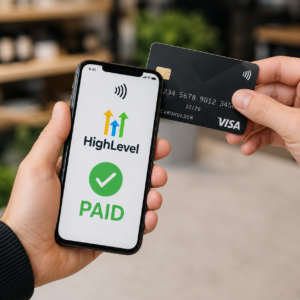
 For years, taking a face-to-face card payment meant having a credit card machine.
For small businesses, companies such as SumUp made this much easier. Buy a relatively inexpensive card reader, connect it to your phone and pay a percentage of each transaction.
| Did you find this content useful? |
|---|
| Sign up for my free Marketing Hints, Tips and Hacks email newsletter every Tuesday at 11am. => Sign up here <= |
But do you actually need the card reader anymore?
If you’re using HighLevel, you can use Tap to Pay technology to take face-to-face payments through the HighLevel mobile app.
But for me, the interesting part isn’t getting rid of a £30 card reader. It’s what happens before and after the payment.
A Payment Terminal Knows You’ve Been Paid. HighLevel Knows Who Paid You
This is the big difference.
If you’re already using HighLevel to manage your customers, the payment doesn’t have to sit in a completely separate system.
It can become part of the customer journey.
Enquiry → Appointment → Deposit → Service → Balance Payment → Review Request → Repeat Business
That’s where I think HighLevel becomes particularly interesting for service businesses.
A payment terminal knows you’ve been paid. A CRM knows who paid you, what they bought and what should happen next.
Example: Take the Balance When the Job Is Finished
Imagine you’re a photographer.
A customer books a £600 photography session and pays a £100 deposit online.
HighLevel manages the appointment, sends the confirmation and reminds the customer beforehand.
You complete the photography session and there is £500 outstanding.
Open the appointment in the HighLevel mobile app and collect the balance there and then.
The customer taps their card against your phone.
Paid.
HighLevel specifically supports collecting the balance of service appointments through the mobile app using Tap to Pay and other payment methods.
See HighLevel’s guide to collecting service appointment payments.
The same principle could apply to a beautician, consultant, cleaner, electrician, plumber, installer or almost any other business providing a service face-to-face.
What About Outstanding Invoices?
This could be particularly useful for trades and other service businesses.
Imagine you’ve just completed a £750 job and the customer already has an outstanding invoice.
HighLevel’s mobile POS can bring together due and overdue invoices, estimates and appointment payments through its Active Transactions functionality.
Instead of leaving and hoping the customer pays later, you can potentially collect the payment while you’re standing in front of them.
Open the transaction. Take the payment. Invoice paid.
Learn more about Active Transactions in HighLevel POS.
Then Let the Automation Take Over
This is where the comparison with a simple card payment system becomes more interesting.
Getting paid doesn’t have to be the end of the process.
A successful payment could become the trigger for what happens next.
Payment received → Thank-you message → Aftercare information → Google review request → Referral request → Future follow-up
That’s why I wouldn’t look at HighLevel Tap to Pay simply as a replacement for a SumUp reader.
It’s another part of an integrated customer management system.
HighLevel Gift Cards Make This Even More Interesting
HighLevel now also has its own electronic gift card functionality.
Businesses can create and sell gift cards, send them directly to customers and track balances and redemptions within HighLevel.
A salon, photographer, therapist or other service business could therefore sell a £100 gift card online and allow the recipient to use that value when paying for a service.
So you potentially have one system handling:
- Online payments
- Deposits
- Invoices
- Face-to-face payments
- Outstanding balances
- Gift cards
And all of this sits alongside the customer’s CRM record.
Read HighLevel’s guide to Electronic Gift Cards.
Read my blog post about selling Electronic Gift Cards.
For businesses selling services rather than traditional ecommerce products, that’s a very useful combination.
What If You Have Several People Taking Payments?
There’s another potential saving which isn’t about transaction fees.
Imagine you have five engineers out visiting customers.
Traditionally, you might buy five card readers.
Those card readers have to be allocated, charged, carried around and replaced if they get lost or damaged.
If your employees already have compatible smartphones, Tap to Pay potentially removes the need for that additional hardware.
Their phone becomes the payment device.
You’ll obviously need to consider permissions, supported devices and how employees access HighLevel, but for mobile teams it’s an interesting use case.
Is HighLevel Tap to Pay Cheaper Than SumUp?
Sometimes. But not always.
And I wouldn’t choose between them purely on the headline transaction fee.
At the time of writing, SumUp’s standard UK pay-as-you-go plan charges 1.69% for most in-person payments.
Its Payments Plus plan costs £19 per month and reduces eligible domestic debit and credit card transactions to 0.99%.
View current SumUp UK pricing.
Stripe’s published UK Terminal pricing is currently 1.4% + 10p for EEA cards, with an additional 10p per Tap to Pay authorisation.
View current Stripe Terminal pricing.
So the cheapest option depends on your average transaction size, volume and the types of cards your customers use.
For lots of smaller payments, SumUp could be cheaper.
For larger transactions, Stripe’s lower percentage can become more attractive compared with SumUp’s standard PAYG rate.
But I think concentrating on a few pence difference misses the bigger point.
The Real Cost Is Often Having Too Many Disconnected Systems
I regularly come across businesses using one system for appointments, another for email marketing, another for payments, another for reviews and perhaps another CRM holding the customer information.
Individually, every piece of software might work perfectly well.
The problem is getting everything to work together. Thats Multi System Chaos.
That’s one of the reasons I like HighLevel.
Rather than continually adding another piece of software every time you need another feature, you can bring more of the customer journey into one system.
Payments are a great example.
Instead of:
Customer → SumUp → Payment
You could have:
Customer → HighLevel Phone App → Payment → CRM Updated → Automation → Review → Repeat Business
The transaction is only one part of the process.
Who Could Use HighLevel Tap to Pay?
I think the strongest opportunity is with businesses that take payment after delivering a service.
- Tradespeople and installers
- Cleaners
- Photographers
- Beauticians and salons
- Therapists
- Consultants and coaches
- Training companies
- Mobile service businesses
- Events and venues
- Home service companies
If you regularly finish a job standing next to your customer and then need to get paid, being able to take that payment using the phone already in your pocket makes a lot of sense.
So, Do You Still Need a Card Reader?
Possibly not.
But I don’t think getting rid of the card reader is actually the most important part.
The bigger opportunity is connecting the payment to everything else you do with that customer.
The enquiry. The appointment. The reminders. The deposit. The invoice. The final payment. The review request. The referral. And eventually the next sale.
That’s where HighLevel Tap to Pay becomes much more than another way of taking a card payment.
It’s another step towards having one connected system managing the complete customer journey.
And for many small service businesses, I think that’s considerably more valuable than saving a few pounds on a card reader.
Frequently Asked Questions
Can HighLevel take contactless payments in person?
Yes. HighLevel’s mobile POS supports Tap to Pay on compatible devices, allowing a customer to make a contactless payment using a supported card or digital wallet.
Do I need a card reader to use HighLevel Tap to Pay?
No. Tap to Pay uses the NFC capabilities of a compatible smartphone, so a separate card reader is not be required. HighLevel also supports compatible Stripe and Square readers where a dedicated terminal is preferred.
Can I take payment for an existing HighLevel invoice?
Yes. HighLevel allows users with the appropriate permissions to collect payment for existing invoices from the mobile app, including using Tap to Pay on supported devices.
Can I take a deposit online and the balance face-to-face?
Yes. This is particularly useful for service businesses. A customer can pay a deposit when booking and the outstanding appointment balance can then be collected through HighLevel’s mobile POS.
Is HighLevel Tap to Pay cheaper than SumUp?
Not always. The cheapest option depends on your transaction values, volume, card types and payment provider. The bigger HighLevel advantage is that the payment can be connected with your CRM, appointments, invoices and marketing automation.
Does HighLevel support gift cards?
Yes. HighLevel allows businesses to create, sell, send and track electronic gift cards. Gift cards can be redeemed through supported HighLevel checkout experiences, making them particularly useful for service and appointment-based businesses.
Who is HighLevel Tap to Pay best suited to?
It is particularly relevant to service businesses that take payments face-to-face, including tradespeople, photographers, cleaners, salons, therapists, consultants, installers, trainers and mobile service teams.
Want to Learn More?
Would you like to learn more about HighLevel? Check out MarketerM8 a HighLevel reseller.
Or book a Discovery Call with Julian to discuss your specific requirements.

About the Author
Julian Mills
HighLevel Consultant & Marketing Automation Strategist
Julian Mills helps business owners automate lead generation, sales follow-up, customer communication and business processes using HighLevel and MarketerM8. Since 2009 he has helped businesses implement CRM, marketing automation and AI-powered systems that save time, improve customer experience and generate more sales.
About Julian
Book a Discovery Call
Join a Free HighLevel Workshop
Learn About HighLevel with MarketerM8

